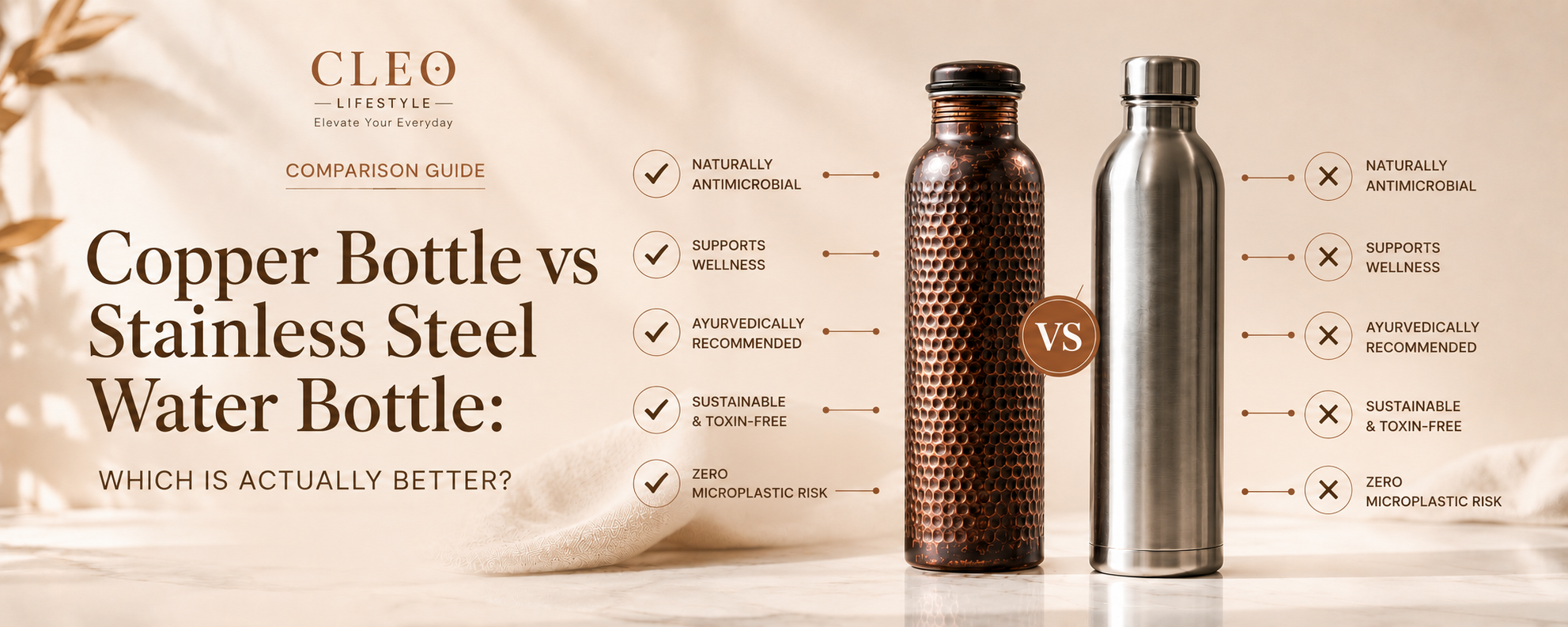

Do Copper Bottles Really Kill Bacteria in Water? The Science Behind It
Do Copper Bottles Really Kill Bacteria in Water?
Yes - copper bottles have a genuine, well-documented antibacterial effect on water. This isn't marketing language. It's a scientific phenomenon called the oligodynamic effect, studied in microbiology labs worldwide. That said, a copper bottle is not a guaranteed water purifier or a substitute for proper water treatment — how well it works depends on temperature, pH and how contaminated the water is to begin with.
Here's exactly how it works, what the research says, and how to use your copper bottle to get the full antimicrobial benefit.

What Is the Oligodynamic Effect?
The word comes from Greek: oligos (few) + dynamis (power). It describes the toxic effect that trace amounts of certain metals - particularly copper and silver — have on microorganisms.
When water makes contact with a copper surface, copper ions (Cu²⁺) slowly dissolve into the water. These ions are lethal to single-celled organisms. Here's what they do:
- Penetrate the cell membrane - copper ions disrupt the lipid layers of bacterial cell walls, making them permeable.
- Interfere with protein function - copper binds to proteins inside the bacterial cell, disrupting essential enzyme activity.
- Generate reactive oxygen species - copper ions trigger the production of hydrogen peroxide within the cell, destroying it from the inside.
- Prevent DNA replication - copper interferes with bacterial DNA, stopping reproduction.
The result: bacteria in your copper bottle are heavily suppressed. In storage studies, water contaminated with common pathogens yielded no culturable bacteria after roughly 16 hours of copper contact. One nuance worth knowing: copper can also push some bacteria into a viable-but-non-culturable state rather than killing every cell outright - so the honest framing is "no culturable bacteria after storage," not a guaranteed total kill of everything in the water.
What Does the Research Actually Say?
Study 1: Sudha et al. (2012), Journal of Health, Population and Nutrition
This is the most frequently cited study on the topic (Sudha VB et al., 2012; PMC3312355). Researchers contaminated drinking water with roughly 500 CFU/mL of diarrhoeagenic bacteria - including E. coli and Salmonella Typhi - stored it in copper vessels at room temperature for 16 hours, and recovered no culturable bacteria afterwards.
In other words, no live, culturable bacteria could be detected after about 16 hours of copper contact. The leached copper measured only around 0.177 mg/L - well within the WHO drinking-water guideline (more on that below).
Study 2: Applied and Environmental Microbiology
A study published in this peer-reviewed journal showed that copper surfaces kill 99.9% of bacteria within 2 hours of contact. While this was testing copper surfaces rather than copper water directly, it demonstrates the potency of copper's antimicrobial action.
Study 3: WHO Guideline on Copper in Water
The World Health Organisation sets a guideline value of 2 mg/L (2,000 µg/L) for copper in drinking water, chosen to protect against acute gastrointestinal effects. This matters here because the amount of copper that leaches from a bottle during overnight storage stays comfortably below that guideline value - so you get the antimicrobial benefit without approaching the safety limit.
Study 4: American Journal of Infection Control
Studies on copper in hospital surfaces found that copper-clad surfaces in patient rooms reduced healthcare-associated infections by 58% compared to standard surfaces. Again — a surface context, but underscoring how potent the effect is.
Which Bacteria Does Copper Kill?
The research covers a wide spectrum of waterborne and surface pathogens:
| Pathogen | Eliminated By Copper | Time Required |
|---|---|---|
| E. coli O157 | Yes | 16 hours |
| Salmonella Typhi | Yes | 16 hours |
| Vibrio cholerae (cholera) | Yes | 16 hours |
| MRSA (Methicillin-resistant Staphylococcus aureus) | Yes (surface) | 90 minutes |
| Influenza A virus | Yes (surface) | 6 hours |
| Legionella | Yes | 4 hours |
| Norovirus | Yes | 30 minutes |
Note: Times shown are from various studies; specific conditions vary.
How Long Does Water Need to Sit for the Effect to Work?
This is the key practical question. The short answer: at least 6–8 hours, with 16 hours being optimal.
The oligodynamic effect is not instantaneous. Copper ions need time to dissolve into the water and reach concentrations sufficient to kill pathogens. Here's a rough timeline:
- 0–2 hours: Minimal antimicrobial effect, copper ion concentration still very low
- 2–6 hours: Growing antimicrobial activity; some bacteria being affected
- 6–8 hours: Significant antimicrobial effect; good for general wellness use
- 16+ hours: Full oligodynamic effect achieved; pathogen elimination documented in studies
The practical takeaway: Fill your Cleo copper bottle at night. Drink the water in the morning. By the time you wake up, the water has had 8+ hours of copper contact - enough to produce meaningful antimicrobial benefit.
Does the Temperature of Water Matter?
Room temperature water is optimal. Cold water slows the ion exchange process; boiling water accelerates it too aggressively and can cause excess copper release (and is not recommended for copper bottles in any case - it can damage the vessel).
The Ayurvedic practice of Tamra Jal specifically calls for water stored at room temperature overnight, which aligns perfectly with what science recommends for maximum antimicrobial benefit.
Does Copper Kill ALL Bacteria?
This is an important nuance. The oligodynamic effect is highly effective against:
- Common gram-negative bacteria (E. coli, Salmonella)
- Gram-positive bacteria (Staphylococcus)
- Many viruses
- Certain fungi
However, a copper bottle is not a guaranteed water purifier and not a substitute for proper water treatment. Its effectiveness depends on temperature, water pH and the level of contamination, and copper may leave some bacteria viable-but-non-culturable rather than fully killing them. If your tap water has heavy bacterial contamination, a copper bottle is an additional layer of protection, not your primary filtration system, and not a replacement for boiling or filtering unsafe water. For normal tap water in countries with treated water infrastructure (UK, UAE, etc.), a copper bottle adds antimicrobial benefit on top of already-safe water.
Does a Dirty Copper Bottle Still Kill Bacteria?
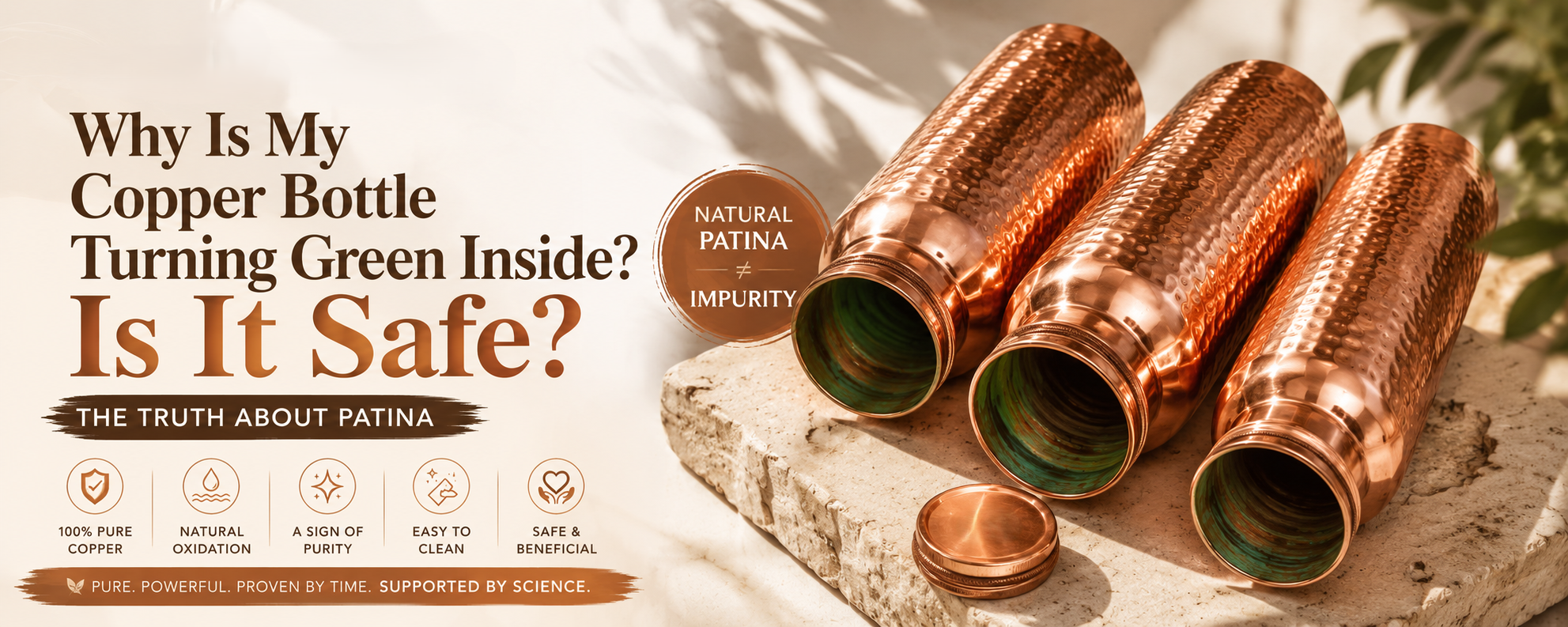
No, and this is critical. If the inside of your bottle is coated in mineral deposits, old water residue, or patina buildup, the copper surface is partially blocked and the ion exchange is impaired.
For your copper bottle to perform its antimicrobial function at full capacity:
- Clean weekly with a natural lemon juice + salt scrub
- Rinse thoroughly after cleaning
- Don't leave water sitting for more than 24 hours before refreshing
See our complete copper bottle cleaning guide for step-by-step instructions.
What About Copper-Plated vs Pure Copper Bottles?
Only pure copper bottles produce the full oligodynamic effect. Copper-plated bottles have a thin copper layer over a base metal (steel, aluminium). The plating:
- Provides some surface-level antimicrobial action initially
- Degrades over time as the coating wears
- Can chip or flake, exposing the base metal
- Does not provide consistent ion release into water
For genuine antimicrobial benefit, the interior of your bottle must be solid, food-grade pure copper. Cleo bottles are made from 99.9%+ pure copper throughout - no plating, no liner.
The Bottom Line
The science is clear: copper bottles kill bacteria through the oligodynamic effect. This is one of the most evidence-backed claims in the wellness drinkware space - acknowledged by the WHO, backed by multiple peer-reviewed studies, and consistent with 5,000 years of Ayurvedic practice.
To get the full benefit: store plain water overnight in a clean, pure copper bottle, and drink it in the morning.
FAQ - Do Copper Bottles Really Kill Bacteria in Water?
Q: How does copper kill bacteria in water?
A: Through the oligodynamic effect - copper ions (Cu²⁺) that dissolve into the water penetrate bacterial cell walls, disrupt essential proteins and enzymes, and trigger internal oxidative reactions that kill the bacteria.
Q: How long does it take for a copper bottle to kill bacteria?
A: In storage studies, about 16 hours of contact time left no culturable major waterborne pathogens (E. coli, Salmonella) in the water. For everyday wellness use, 6–8 hours (overnight) provides meaningful antimicrobial activity. It is not instant and not a guaranteed sterilisation - treat it as a helpful extra layer, not a water purifier.
Q: Does a copper bottle work like a water filter?
A: Not exactly. A filter physically removes particles and pathogens. A copper bottle uses ion chemistry to destroy bacteria already in the water. They work differently but complement each other. If you're using filtered tap water, a copper bottle adds an extra layer of antimicrobial protection.
Q: Does cold water reduce the antimicrobial effect?
A: Yes, cold temperatures slow ion exchange. Room temperature water produces optimal copper ion concentrations. This is why the Ayurvedic practice uses room-temperature water stored overnight.
Q: Does the antimicrobial effect work with alkaline or filtered water?
A: Yes, though very alkaline water can slightly slow the rate of ion release. The effect is still present, though the timeline may be marginally longer than with neutral pH water.
Discover Cleo's pure copper water bottles - built for genuine antimicrobial benefit and everyday wellness.
Sources