
Copper Bottle vs Stainless Steel: Which Is Better for Your Health?
Copper Bottle vs Stainless Steel
Stainless steel wins on convenience and temperature retention. Copper wins on health benefits and antimicrobial properties. The best choice depends on what you're prioritising.
This guide goes category by category so you can decide what's right for you - without any brand spin.

Quick Comparison Table
| Feature | Copper | Stainless Steel |
|---|---|---|
| Antimicrobial | Yes - leaves no culturable bacteria after ~16h storage | Limited - passive barrier only |
| Health benefits | Active (copper ions, trace minerals) | Passive (no leaching, neutral) |
| Temperature retention | Room temperature only | Excellent (insulated versions hold temp 12–24 hrs) |
| Taste | Neutral to slight mineral | Neutral |
| Cleaning | Requires weekly natural cleaning | Dishwasher safe (most) |
| Durability | 10–20+ years | 10–20+ years |
| Eco-friendliness | Excellent (recyclable, natural) | Good (recyclable, but energy-intensive to produce) |
| Cost | £25–£60 for quality | £15–£50 |
| Weight | Slightly heavier | Lighter (insulated versions heavier) |
| Best for | Health-focused, wellness routines | Gym, travel, temperature-sensitive use |
Health Benefits: Copper Wins
Stainless steel is chemically inert. It does not interact with water at all - which is a feature if you're worried about contamination, but it also means you get zero health benefit from the material itself. Stainless steel is a storage vessel, nothing more.
Copper, by contrast, is an active material. Copper ions naturally leach into water stored in the vessel, providing:
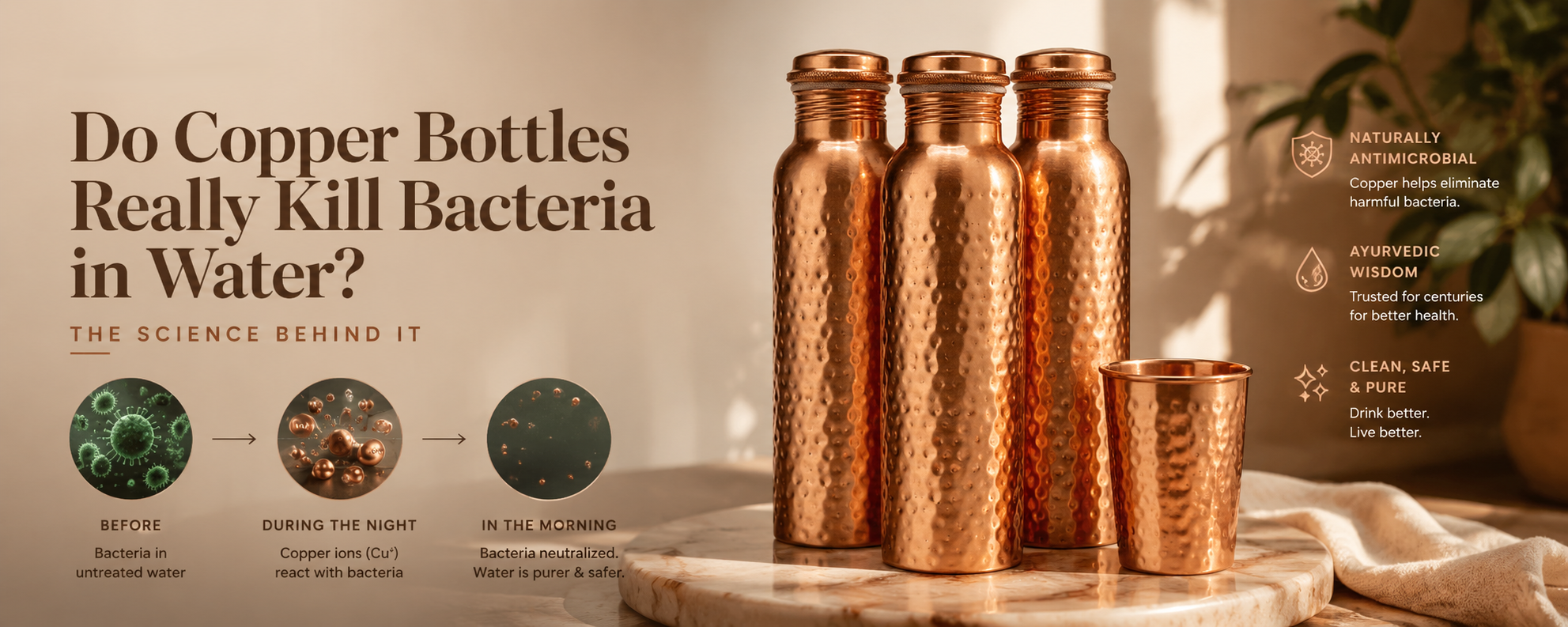
- Antimicrobial action - in one study, water deliberately contaminated with diarrhoeagenic bacteria (including E. coli and Salmonella Typhi) and stored in copper at room temperature yielded no culturable bacteria after ~16 hours (Sudha et al. 2012, Journal of Health, Population and Nutrition). Effectiveness depends on temperature, pH, and contamination level, and copper can render some bacteria viable-but-non-culturable rather than fully killing them. A copper bottle is not a guaranteed water purifier or a substitute for proper water treatment.
- Trace mineral supplementation - copper is an essential mineral involved in iron absorption, connective-tissue formation (as a cofactor for lysyl oxidase, the enzyme that cross-links collagen and elastin), and immune function
- Anti-inflammatory properties - copper's antioxidant activity helps neutralise free radicals
- Digestive support - Ayurvedic practice and emerging research both support copper water's role in gut health
Winner: Copper - for active health benefits. Stainless steel is a neutral vessel; copper is a functional one.

Safety: It's a Draw (with Notes)
Both materials are safe when used correctly.
Stainless steel is essentially inert. It doesn't leach anything into water, even at high temperatures or with acidic liquids. It's the lowest-risk material in terms of chemical interaction. The concern with some cheap stainless steel bottles is the use of low-grade steel that may contain nickel or other metals - always look for food-grade 18/8 or 316 stainless steel.
Copper is safe for most people at the trace levels produced by normal overnight water storage (typically around 0.18–0.48mg/L after 8–16 hours, well below the WHO guideline value of 2mg/L). Levels rise only slowly with longer storage, reaching roughly 0.8mg/L only after several days — still under the guideline value. The key caveats: avoid storing acidic liquids (lemon juice, citrus, vinegar drinks) long-term, as acidity increases copper leaching; clean regularly; and take periodic breaks from daily use. People with Wilson's disease must avoid copper water bottles, and those with other liver conditions should consult a doctor.
Winner: Draw - both are safe when you buy quality versions and use them correctly. Stainless steel has a slightly wider safety margin (no cleaning requirement, no acidic liquid restriction). Copper requires a bit more care but is still very safe.
Antimicrobial Properties: Copper Wins Convincingly
This is where copper is genuinely unmatched.
The oligodynamic effect - copper's ability to inactivate microorganisms through ion activity - has been documented across many peer-reviewed studies. No metal commonly used in water bottles matches copper's antibacterial action. Stainless steel does not inactivate bacteria; it simply doesn't provide a favourable environment for growth (unlike plastic).
That said, results depend on temperature, pH, and the level of contamination, and a copper bottle should not be treated as a guaranteed water purifier or a replacement for proper water treatment. It's an added benefit, not a substitute for safe water.
Winner: Copper - not even close on antimicrobial properties.
Temperature Retention: Stainless Steel Wins
This is the one area where stainless steel is clearly superior - specifically insulated (double-wall vacuum) stainless steel bottles.
A quality insulated stainless steel bottle keeps drinks cold for 24 hours and hot for 12 hours. They're the go-to for gym sessions, office use, travel, and outdoor activities where you want your water at a specific temperature.
Copper is not recommended for use with boiling water (it can damage the finish) and is not insulated, so your water will be room temperature after a short time in warm weather. The Ayurvedic practice specifically recommends room-temperature copper water — so this isn't a flaw in the traditional sense, but it's a practical limitation for modern use.
Winner: Stainless Steel - if temperature matters to you.
Taste: Copper Has a Slight Edge
Stainless steel is truly neutral in taste - most people can't detect anything from the bottle material.
Copper imparts a very subtle mineral quality to water after overnight storage. Many people describe it as "cleaner" tasting - particularly compared to water from plastic or standard tumblers. The slight mineral flavour is the copper ions at work and is considered pleasant by most copper bottle users. Some people are more sensitive to it and take a few days to adjust.
Winner: Copper (narrowly) — the mineral quality is appealing for many. If you want completely neutral taste, stainless steel is a safe choice.
Maintenance: Stainless Steel Wins
Stainless steel is nearly maintenance-free. Most bottles are dishwasher-safe. Rinse and go.
Copper requires weekly cleaning with a natural lemon-and-salt scrub to prevent oxidation buildup and patina development on the interior. You should avoid harsh chemical cleaners (they strip the copper) and never put a copper bottle in the dishwasher. The maintenance is simple and quick (5 minutes weekly) but it is a real commitment that stainless steel doesn't require.
Winner: Stainless Steel - lower maintenance, more flexible.
Eco-Friendliness: Copper Wins (Slightly)
Both copper and stainless steel are infinitely recyclable — far superior to plastic. Both are durable and long-lasting.
The edge goes to copper because:
- Copper mining, while impactful, requires less processing energy than stainless steel production.
- Copper is a natural material - no synthetic coatings or polymer linings required.
- When a copper bottle reaches end-of-life, it's 100% pure metal - no composite materials to separate.
Both are genuinely sustainable choices compared to plastic. If you're choosing between two well-made versions of each, the eco difference is minimal.
Winner: Copper (narrowly)
Cost: Stainless Steel Wins
You can get a reliable stainless steel bottle from £15. Quality insulated options run £25–£45.
Pure copper bottles (not plated) typically cost £25–£60 for good quality. The higher cost reflects real material value — pure copper is a commodity metal — and the craftsmanship of hand-hammered versions like Cleo's.
Both are investments that pay for themselves quickly compared to buying single-use bottles.
Winner: Stainless Steel lower entry price, especially for everyday use cases.
Which Should You Buy?
Choose Copper if:
- You want the antimicrobial and health benefits of Tamra Jal (Ayurvedic copper water)
- You drink water at room temperature
- You're focused on holistic wellness and trace mineral intake
- You appreciate handcrafted, artisanal products
- You want a morning wellness ritual backed by 5,000 years of tradition and modern science
Choose Stainless Steel if:
- You need temperature retention (hot coffee, ice-cold water at the gym)
- You want zero-maintenance hydration
- You drink a large volume of water all day and want one vessel
- You're on a tight budget
The ideal setup (what many Cleo customers do): Use a copper bottle for your morning 2–3 glasses of water (the Tamra Jal ritual), and a stainless steel insulated bottle for the rest of the day. You get the best of both.
FAQ - Copper Bottle vs Stainless Steel
Q: Is copper safer than stainless steel?
A: Both are safe when used correctly. Stainless steel is completely inert, giving it a slightly wider safety margin. Pure copper used for overnight water storage stays well within the WHO guideline value (2mg/L). Low-quality copper-plated bottles, however, can be less predictable.
Q: Does stainless steel have any health benefits?
A: Stainless steel is chemically neutral - it doesn't harm you, but it also doesn't actively benefit you through the vessel material. Its benefits are functional: durability, temperature retention, and zero maintenance.
Q: Can I use both a copper and stainless steel bottle?
A: Absolutely. Many wellness-conscious users use a copper bottle for morning rituals and a stainless steel for hydration throughout the day.
Q: Does copper taste different from stainless steel?
A: Stainless steel is tasteless. Copper water has a subtle mineral quality after overnight storage that most people find pleasant. If you're very taste-sensitive, start with shorter storage times and build up.
Q: How long do copper and stainless steel bottles last?
A: Both, if well-maintained, last 10–20+ years. Copper develops a natural patina over time (which is normal and harmless). Stainless steel retains its appearance longer without maintenance.
Sources
- Michigan State University Extension — Steel, Glass, and/or Plastic Bottles: What is the best choice?
Explore Cleo's pure copper water bottles — crafted for those who take their wellness seriously.