
Tamra Jal: The Ancient Ayurvedic Practice of Drinking Copper Water - and What Modern Science Says
The Ancient Ayurvedic Practice of Drinking Copper Water
Tamra Jal (Sanskrit: tamra = copper, jal = water) is the 5,000-year-old Ayurvedic practice of storing drinking water in pure copper vessels overnight and consuming it in the morning. It is one of the oldest, most consistently documented wellness practices in human history - and modern microbiology is increasingly validating what Ayurvedic physicians knew millennia ago.
This guide covers the history, the Ayurvedic philosophy, what modern science confirms (and what it doesn't), how to practise Tamra Jal correctly, and why copper water bottles like Cleo's are designed specifically with this tradition in mind.

What Is Tamra Jal?
In Ayurveda - the ancient Indian system of medicine documented in texts dating back over 5,000 years - copper (tamra) is considered one of the most therapeutically valuable metals. The Charaka Samhita, one of the foundational texts of Ayurvedic medicine, specifically prescribes drinking water stored in copper vessels as a daily health practice.
The practice is simple: fill a pure copper vessel with water in the evening. Leave it overnight at room temperature. Drink the water on an empty stomach in the morning.
The Sanskrit texts describe copper-stored water (tamra jal) as having these properties:
Tridoshic balance - it balances all three doshas (Vata, Pitta, Kapha), which in Ayurveda represents optimal health
- Deepana - kindles the digestive fire (agni)
- Pachana - promotes efficient digestion
- Raktaprasadana - purifies the blood
- Antimicrobial - helps protect against waterborne disease (described in terms consistent with modern germ theory, remarkable given the era)
For centuries, this practice was observed across India, the Middle East, and other ancient civilisations that used copper vessels for water storage. The shift away from copper occurred with the industrialisation of water treatment and the mass production of plastic containers — not because copper water was proven ineffective, but because it became inconvenient.
Why Did Ayurvedic Practitioners Choose Copper?
Ancient Ayurvedic physicians were systematic observers. They didn't have microscopes, but they had thousands of years of empirical observation. They noted that:
- Water stored in copper containers did not cause the waterborne illnesses that plagued communities using other vessels.
- People who drank from copper vessels consistently reported better digestion and fewer gut complaints.
- Copper water had different sensory properties - a subtly mineral quality - that distinguished it from water stored in clay or wood.
They also understood copper as part of a broader framework of health: a daily mineral intake that supported what we now call the immune system, the digestive system, and the circulatory system.
In Ayurveda, the practice isn't just about the water. It's about creating a mindful morning ritual - waking, drinking copper water before anything else (including food, coffee, or filtered water), and allowing the body to receive the water's properties in a fasted, receptive state.

What Modern Science Confirms
The ancient claims hold up remarkably well under scientific scrutiny.
1. The Antimicrobial Claim: Strongly Supported
In a 2012 study by Sudha et al. in the Journal of Health, Population and Nutrition, water was deliberately contaminated with around 500 CFU/mL of diarrhoeagenic bacteria (including E. coli and Salmonella Typhi), stored in copper at room temperature for about 16 hours, and afterward yielded no culturable bacteria. This is a striking result, but worth framing precisely: it's "no culturable bacteria after ~16 hours," not a guaranteed total kill. Effectiveness depends on temperature, pH, and the level of contamination, and copper may render some bacteria viable-but-non-culturable rather than fully killing them.
Importantly, a copper bottle is not a guaranteed water purifier and should not be treated as a substitute for proper water treatment. If your water source is unsafe, treat it conventionally first.
The Ayurvedic claim that copper water is protective against waterborne illness = strongly supported by modern microbiology, with sensible caveats.
2. The Digestive Benefit: Partially Confirmed
Copper plays a confirmed biochemical role in gut function - it supports the production of digestive enzymes, has anti-inflammatory properties, and contributes to healthy gut motility. Clinical studies on copper's direct digestive effects are limited in scale, but the biochemical mechanism is well-established.
The Ayurvedic claim that copper water improves digestion = biochemically plausible, anecdotally strong, and clinically promising.
3. The Tridoshic Balance Claim: Unverified by Western Science
Modern science doesn't use the framework of Vata/Pitta/Kapha doshas, so this claim cannot be directly tested. It's a philosophical framework, not a biochemical one. Whether copper water "balances your doshas" depends on whether you engage with Ayurvedic philosophy.
The Ayurvedic tridoshic claim = not verifiable by Western scientific methodology.
4. The Blood Purification Claim: Partially Confirmed
Copper supports iron absorption, which is essential for healthy haemoglobin production. It also has antioxidant properties. These are not the same as "purifying the blood" in a dramatic sense, but they do support blood health.
The Ayurvedic blood purification claim = partially supported by modern biochemistry.
A Note on Safety
The copper that leaches into water during overnight storage stays comfortably below the WHO guideline value for copper in drinking water, which is 2 mg/L (set to protect against acute gastrointestinal effects). Two practical caveats apply, though. First, people with Wilson disease - a genetic disorder of copper accumulation - must avoid copper water bottles entirely. Second, store only plain water: acidic liquids such as lemon juice, citrus drinks, or vinegar-based drinks substantially increase copper leaching, so avoid leaving acidic drinks in a copper vessel for extended periods.
How to Practise Tamra Jal Correctly
The traditional practice, adapted for modern life:
Evening Preparation (2 minutes)
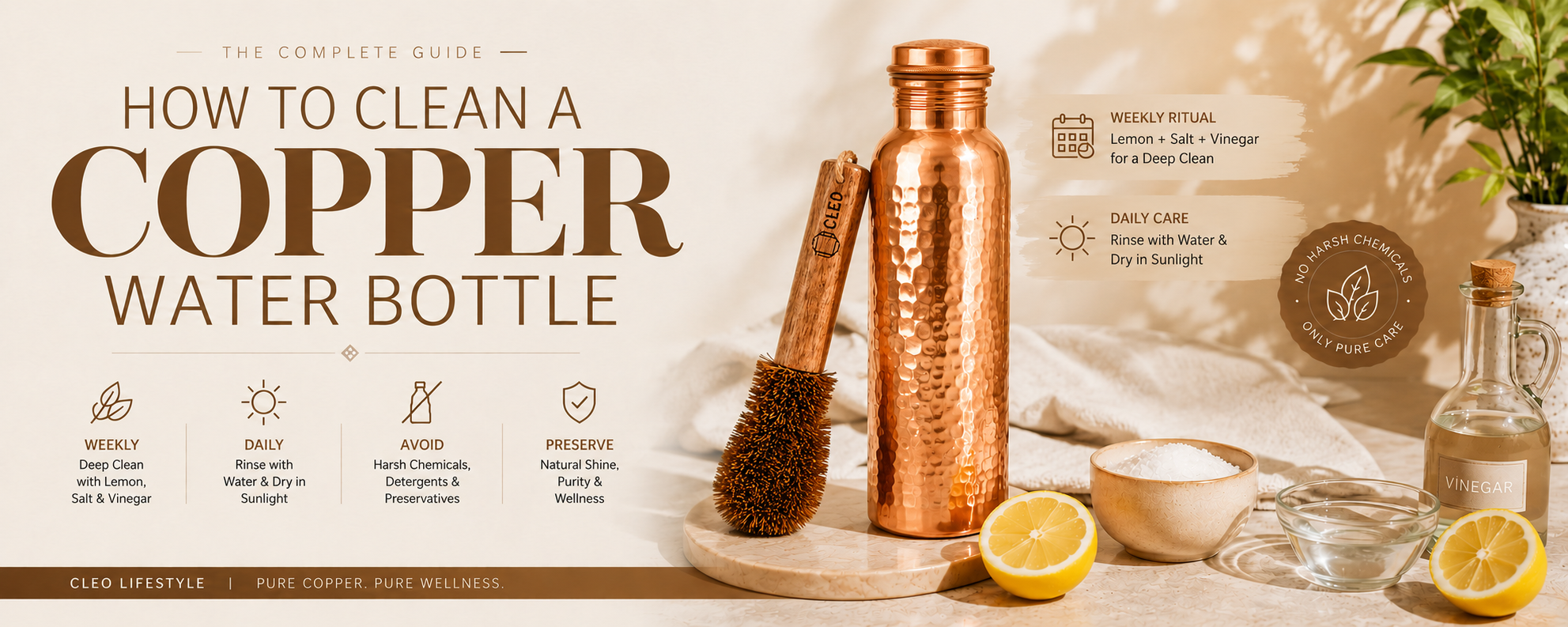
1. Clean your copper vessel (weekly with lemon-salt; daily rinse)
2. Fill with fresh, clean water, ideally filtered tap water at room temperature
3. Leave on your bedside table or kitchen counter, uncapped, covered with a small cloth or lid to keep out dust
4. Storage time: minimum 6 hours, optimal 8–12 hours
Morning Ritual (2 minutes)
1. On waking, before coffee, tea, food, or other water, drink 2–3 cups of the copper water
2. Drink slowly and intentionally - Ayurveda emphasises mindfulness in this practice
3. Wait 20–30 minutes before eating breakfast
4. The fast from sleep means your gut is receptive; the copper water is meant to prepare your digestive system for the day
Volume Guidance
The traditional prescription is 1–3 glasses (250–750ml) first thing in the morning. This is not a "drink copper water all day" practice in the traditional sense. The morning ritual is the core of Tamra Jal.
How to Know if It's Working
Ayurvedic practitioners look for these indicators over weeks of practice:
- Improved digestion (less bloating, more regular bowel movements)
- Improved skin clarity
- More consistent energy levels
- Reduced frequency of minor illness
- Improved sleep quality (indirect - better gut health is linked to better sleep)
These are subjective and multi-causal, so they should be understood as general wellness indicators, not clinical outcomes. On the skin point specifically: copper is a required cofactor for lysyl oxidase, the enzyme that cross-links collagen and elastin, so adequate copper supports normal collagen structure. That is a long way from saying copper water visibly boosts collagen or reverses wrinkles - dietary copper deficiency is rare, and any skin benefit here is supportive of normal processes, not a treatment.
The Best Copper Vessels for Tamra Jal
In traditional Ayurveda, the vessel should be:
- Pure copper - not copper-plated, coated, or mixed with other metals
- Unlined - no interior coating of any kind (this blocks the ion exchange)
- Handmade (ideally) - hand-hammered vessels were the traditional form, and artisanal manufacturing is associated with better material quality
Cleo's copper water bottles are made exactly to these specifications: pure copper (99.9%+), unlined interior, hand-hammered. The hammered finish isn't just aesthetic — it increases the surface area in contact with water, potentially enhancing the ion exchange that makes Tamra Jal effective.
Tamra Jal and Fasting
Many practitioners combine Tamra Jal with intermittent fasting. Copper water in the morning, during the fasted window, is considered consistent with most fasting protocols because:
- It contains essentially zero calories
- The trace copper ions don't break ketosis
- It supports the digestive preparation that makes breaking the fast easier
This is one reason copper bottles have become popular in wellness and biohacking communities beyond traditional Ayurveda.
How Long Before You Notice Benefits?
Expectations vary significantly. Anecdotal reports and traditional Ayurvedic guidance both suggest:
- Week 1–2: Mainly getting accustomed to the taste and routine
- Week 3–4: Some people notice improved digestion and energy
- Month 2–3: Some report better skin clarity alongside sustained digestive benefits, though skin effects are anecdotal rather than clinically demonstrated
- 6 months+: Ayurvedic tradition considers this a long-term daily practice, not a short-term intervention
The mindset in Ayurveda is of gradual, sustainable wellness building - not rapid intervention. Tamra Jal is a daily practice for life, not a 30-day challenge.
FAQ - Tamra Jal: The Ancient Ayurvedic Practice of Drinking Copper Water
Q: What does "Tamra Jal" mean?
A: Tamra Jal is Sanskrit for "copper water." *Tamra* means copper and *jal* means water. It refers to the Ayurvedic practice of drinking water that has been stored overnight in a pure copper vessel.
Q: How long should water sit in a copper vessel for Tamra Jal?
A: A minimum of 6 hours, with 8–12 hours considered optimal. The traditional practice involves filling the vessel at night and drinking the water first thing in the morning.
Q: Does Tamra Jal break a fast?
A: No. The trace copper ions are mineral in nature, have no caloric content, and do not trigger an insulin response. Tamra Jal is compatible with intermittent fasting.
Q: Is Tamra Jal the same as copper-infused water sold in bottles?
A: No. Commercially prepared "copper water" products are different - they're processed and may not be made by the traditional method. Authentic Tamra Jal involves storing water in a pure copper vessel yourself. The vessel contact and the overnight process are considered integral parts of the practice.
Q: Can I practise Tamra Jal with cold water?
A: Traditional Ayurveda recommends room-temperature water, not refrigerated water. Cold water is thought to be harder for the digestive system to process in the morning, and warmer temperatures support better copper ion exchange.
Sources
Experience Tamra Jal with Cleo's handcrafted pure copper water bottles - made for this practice, built to last a lifetime.