
Copper Water Bottle in Ayurveda: What Is Tamra Jal?
If you've seen a gleaming copper water bottle on a yoga mat or a kitchen counter, you're looking at a very old habit in a modern form. In Ayurveda, water stored overnight in a copper vessel is called Tamra Jal: tamra means copper and jal means water. For generations, families across India drank from copper vessels without a second thought.
This guide covers where the practice comes from, how to make Tamra Jal in a copper water bottle, what modern research does and doesn't support, and how to use it safely. Looking for a bottle now? Browse our copper water bottle.
In this guide
- What Is Tamra Jal in Ayurveda?
- Ancient Copper Water Bottles: A Brief History
- How to Make Tamra Jal in a Copper Water Bottle
- Why Yogis Use a Copper Water Bottle for Yoga
- 7 Chakra Copper Water Bottle: What the Design Means
- Does Copper Water Work? What Research Shows
- Is Copper Water Safe? Who Should Avoid It
- How to Clean a Copper Water Bottle
- How to Choose a Quality Copper Water Bottle
- Copper vs Stainless Steel Water Bottles
- Frequently Asked Questions About Copper Water
What Is Tamra Jal in Ayurveda?
Tamra Jal (also spelled Tamra Jala) is water stored in a pure copper vessel, traditionally for 6 to 8 hours or overnight, and drunk the next morning. Today most people make it by filling a copper water bottle with plain water at night.
Classical Ayurvedic texts, including the Sushruta Samhita, describe copper (tamra) and its uses. In the Ayurvedic framework, Tamra Jal is traditionally described as supportive of all three doshas (Vata, Pitta and Kapha), though sources differ on which it favors most. The doshas are a framework from traditional medicine, not a scientific measurement. Treat them as the tradition's own way of understanding the body.

Ancient Copper Water Bottles: A Brief History
The long history is part of why the practice endures. Copper is one of the first metals people ever worked, and it has been used for tools and vessels for thousands of years. Ancient Egyptian, Indian and Sumerian cultures are reported to have used copper and silver vessels for water, and ancient Ayurvedic texts mention storing water in copper pots for purification. Many Indian households still keep a tamba (copper) pot or jug for drinking water.
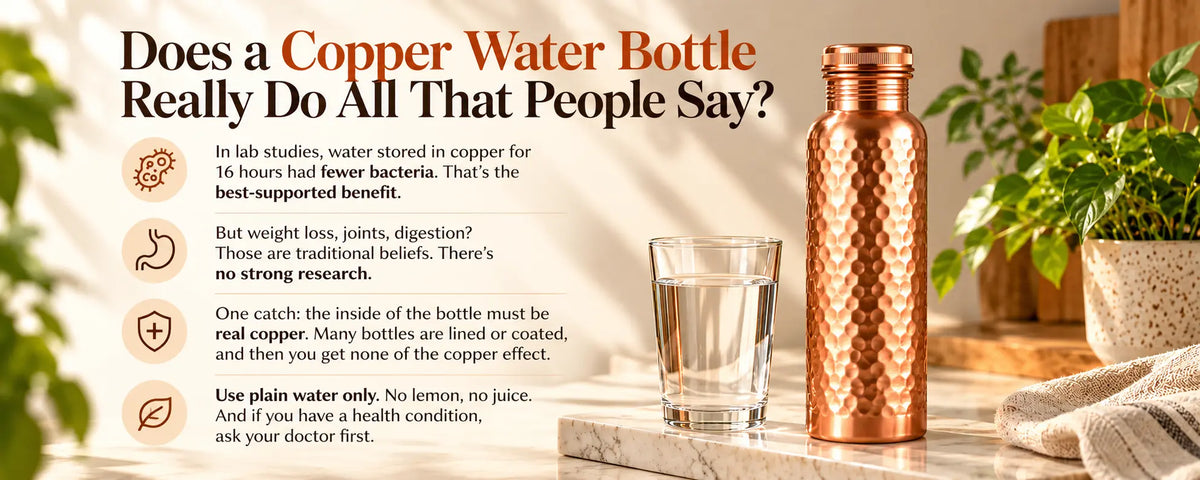
What makes copper unusual is a property researchers have confirmed: it is naturally antimicrobial. A study by Sudha and colleagues in the Journal of Health, Population and Nutrition deliberately contaminated drinking water with diarrhea-causing bacteria, including E. coli and Vibrio cholerae, and stored it in copper pots at room temperature. After 16 hours, no bacteria could be recovered. That was a laboratory test, not a home bottle, but it plausibly helps explain why the habit lasted so long, long before anyone could see bacteria.
How to Make Tamra Jal in a Copper Water Bottle
- Fill the bottle with plain, room-temperature water. Filtered tap water or still water works well.
- Let it rest for 6 to 8 hours, commonly overnight. This is the traditional timing.
- Drink it in the morning, traditionally on an empty stomach, before tea or coffee.
- Empty and refill with fresh water. Don't leave the same water in the bottle for days.
Most people drink one to two glasses and use a regular bottle for the rest of the day. There's no need to drink large amounts of copper water. Our handcrafted pure copper water bottle holds 34 oz (about 1 liter), enough for the overnight method.
Important: a copper bottle is not a water-treatment device. Start with water that is already safe to drink.

Why Yogis Use a Copper Water Bottle for Yoga
A yoga copper water bottle fits the morning routine naturally. Plenty of people pour a glass of Tamra Jal, sit for a few minutes of breathing, then move into their practice. It becomes a small ritual: water, stillness, movement.
There are practical reasons too. Copper bottles are sturdy, don't hold onto odors the way some plastic does, and are free of plastic. Many people also like the warm color and hand-hammered look as a reminder to start the day slowly.

7 Chakra Copper Water Bottle: What the Design Means
A 7 chakra copper water bottle is engraved or decorated with the seven energy centers of yogic tradition, from the root chakra to the crown chakra. The design is symbolic. It's a way of tying hydration to a mindfulness practice, and many people find it meaningful.
To be clear about what this is: the chakras belong to yogic and spiritual tradition, and there is no scientific evidence that an engraving changes the water. The copper behaves the same either way. If a chakra design helps you stay consistent with your routine, that's a perfectly good reason to choose one.
Does Copper Water Work? What Research Shows
Here is an honest summary. For a deeper look, read what the evidence actually says about copper water bottle benefits.
What research supports
- Copper has antimicrobial properties, and copper pots reduced bacteria in contaminated stored water in laboratory testing.
- Copper is an essential trace mineral, meaning the body needs a small amount of it. The NIH Office of Dietary Supplements covers daily needs and limits.
What isn't well established
- Claims that Tamra Jal treats or cures specific conditions, supports weight loss, or "detoxifies" the body. Strong human clinical evidence for these claims is limited, so be cautious with anyone who promises them.
Think of copper water as a traditional wellness habit with a plausible hygiene benefit, not as a medicine. These statements have not been evaluated by the FDA, and this article is not medical advice.
Is Copper Water Safe? Who Should Avoid It
Copper is an essential mineral, but more is not better. Whether it is safe to drink every day comes down to a few simple rules:
- Plain water only. Acidic drinks such as lemon water, juice, vinegar-based drinks and soda can leach too much copper.
- Don't leave water sitting for days. Stick to the traditional 6 to 8 hours, then empty and refill.
- Keep quantities modest. One to two glasses a day is a common practice, not a medical recommendation.
- No hot liquids, microwave or freezer.
Who should check with a doctor first: anyone with a condition that affects copper metabolism, such as Wilson's disease, and anyone who is pregnant, has liver or kidney problems, or takes medication that interacts with minerals.
For context, the World Health Organization's guideline value for copper in drinking water is 2 mg/L, the U.S. EPA's action level for public water systems is 1.3 mg/L, and the U.S. adult upper intake level from all sources is 10 mg per day. In the Sudha study, water stored 16 hours in copper pots measured about 0.18 mg/L (177 ppb). Your own results will vary with the bottle, the water and the time it sits, which is why the rules above matter.
How to Clean a Copper Water Bottle
Copper naturally darkens over time. That's normal and is not a sign the bottle is unsafe.
- Mix a little lemon juice or white vinegar with salt.
- Rub gently with a soft cloth or sponge, inside and out.
- Rinse thoroughly with water and dry.
- Repeat every week or two, depending on use.
Avoid the dishwasher and harsh scrubbers, which can damage the surface. Rinse well after cleaning so no acidic residue stays in the bottle.

How to Choose a Quality Copper Water Bottle
Not every bottle that looks like copper is copper. Look for:
- Pure, food-grade copper, not copper plating or an alloy with unknown metals
- A clear material description from the seller
- Solid construction with a well-fitting, leak-resistant lid
- No lacquer or coating on the inside, since a coating blocks contact between the water and the copper
Copper vs Stainless Steel Water Bottles
Both are durable and plastic-free, but they do different jobs.
| Copper bottle | Stainless steel bottle | |
|---|---|---|
| Water contact | Water touches copper, so it picks up trace copper | Inert, adds no minerals |
| Antimicrobial effect | Yes, shown in lab studies on stored water | No |
| Best use | Plain water stored overnight (Tamra Jal) | All-day use, including hot, cold, acidic or flavored drinks |
| Insulation | Single wall, not insulated | Often double-walled and insulated |
| Care | Hand wash, occasional polishing | Usually dishwasher safe |
Many people keep both: a copper bottle for the morning Tamra Jal routine and a stainless bottle for the rest of the day.
Frequently Asked Questions About Copper Water
What is Tamra Jal?
Tamra Jal is water stored in a pure copper vessel, traditionally overnight, in Ayurvedic practice. Tamra means copper and jal means water.
How long should water sit in a copper water bottle?
Traditionally 6 to 8 hours. Empty and refill the bottle rather than letting the same water sit for days.
When is the best time to drink copper water?
Most people drink it in the morning, often on an empty stomach, though there is no strict rule.
Can you drink copper water on an empty stomach?
Many people do, as the tradition suggests. If you have a sensitive stomach or a medical condition, ask your doctor first.
How much copper water per day is safe?
One to two glasses is a common practice. The U.S. adult upper intake level for copper from all sources is 10 mg per day, so keep copper water modest and use a regular bottle for the rest of your water.
Can I drink copper water every day?
Many people do, in modest amounts. If you have a medical condition or take medication, ask your doctor first.
Can I put lemon water in a copper bottle?
No. Acidic liquids can pull too much copper into the drink. Keep it to plain water.
Does copper water help with weight loss?
Strong human evidence for this claim is lacking. Treat copper water as a hydration habit, not a weight-loss tool.
Who should not drink copper water?
Anyone with Wilson's disease or another copper-metabolism condition should avoid it, and people who are pregnant or have liver or kidney problems should ask a doctor first.
Does a 7 chakra copper water bottle work differently?
No. The chakra design is symbolic. The water interacts with the copper the same way regardless of the engraving.
Does copper water have scientific backing?
Copper's antimicrobial effect on stored water is supported by laboratory research. Broader health claims are less well established.
The Takeaway
Tamra Jal is a simple, centuries-old habit: plain water, a copper vessel, a little patience. Whether you come to it through Ayurveda, yoga or just a love of well-made things, it works best when kept simple and safe. Use plain water, let it rest overnight, drink it in moderation, and keep your bottle clean.
Ready to start? Explore our handcrafted pure copper water bottle.
These statements have not been evaluated by the FDA. This content is for general information and is not medical advice.
Sources
- Sudha VB, Ganesan S, Pazhani GP, et al. Storing drinking-water in copper pots kills contaminating diarrhoeagenic bacteria. Journal of Health, Population and Nutrition. 2012;30(1):17-21.
- NIH Office of Dietary Supplements: Copper fact sheet
- U.S. EPA: Lead and Copper Rule
- World Health Organization, Guidelines for Drinking-water Quality (copper guideline value 2 mg/L)